
The technology industry is changing faster than ever, and cloud computing has become one of the most important areas of modern IT infrastructure. Businesses of all sizes are moving their applications, databases, storage systems, and digital services to the cloud because it provides flexibility, scalability, cost efficiency, and improved accessibility.
As organizations continue adopting cloud technologies, the demand for IT professionals with strong cloud computing skills is increasing rapidly. Whether someone works in system administration, software development, cybersecurity, networking, data engineering, or IT support, understanding cloud platforms has become a valuable career advantage.
Cloud computing is no longer considered a specialized skill only for cloud engineers. It has become an essential part of modern IT knowledge.
In this article, we will explore the cloud computing skills every IT professional should learn to stay competitive, improve career opportunities, and succeed in today’s digital environment.
What Is Cloud Computing?
Cloud computing refers to the delivery of computing resources through the internet instead of relying only on local hardware.
These resources can include:
- Servers
- Storage
- Databases
- Networking
- Software applications
- Security tools
- Artificial intelligence services
Instead of purchasing and maintaining expensive physical infrastructure, organizations can use cloud services whenever needed and scale resources according to demand.
Major cloud providers include:
These platforms provide thousands of services used by startups, enterprises, government organizations, and technology companies worldwide.
Why Cloud Computing Skills Are Important for IT Professionals
Cloud technology has transformed how companies build and manage digital systems.
Traditional IT environments often required organizations to purchase servers, maintain physical data centers, and manually configure infrastructure.
Cloud computing changed this approach by allowing businesses to access powerful computing resources instantly.
For IT professionals, cloud knowledge provides several benefits:
- Better career opportunities
- Higher earning potential
- Ability to manage modern infrastructure
- Improved understanding of digital transformation
- Opportunities in emerging technology fields
Companies increasingly prefer professionals who understand both traditional IT concepts and cloud-based solutions.
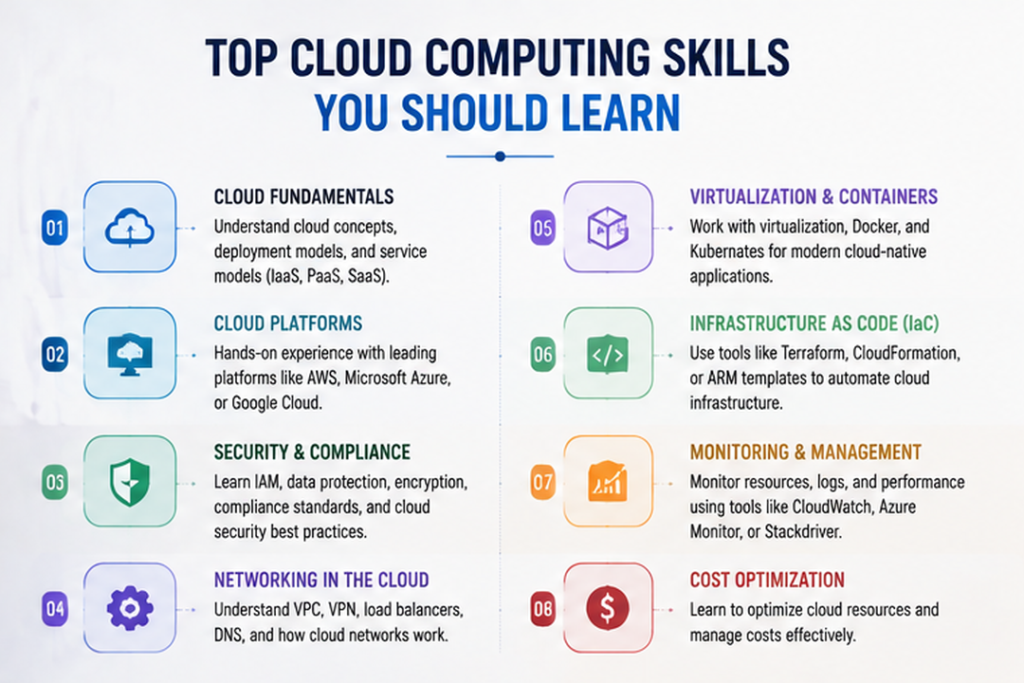
1. Understanding Cloud Computing Fundamentals
Before learning advanced cloud technologies, IT professionals should understand the basic concepts of cloud computing.
Important fundamentals include:
Cloud Service Models
Infrastructure as a Service (IaaS)
IaaS provides virtualized computing resources such as servers, networks, and storage.
Examples include virtual machines and cloud networking services.
Platform as a Service (PaaS)
PaaS provides developers with platforms where they can build and deploy applications without managing underlying infrastructure.
Software as a Service (SaaS)
SaaS delivers software applications through the internet.
Examples include online collaboration tools, customer management platforms, and productivity applications.
Understanding these models helps IT professionals choose the right cloud solutions for different business needs.
2. Cloud Platform Knowledge
One of the most valuable skills for IT professionals is understanding major cloud platforms.
Each platform has its own services, tools, and management systems.
Amazon Web Services (AWS)
AWS is one of the largest cloud platforms worldwide.
Professionals should understand services such as:
- Virtual servers
- Cloud storage
- Databases
- Networking
- Identity management
- Monitoring tools
Microsoft Azure
Azure is widely used by organizations that rely on Microsoft technologies.
Important areas include:
- Virtual machines
- Azure Active Directory
- Cloud databases
- Application services
- Security solutions
Google Cloud Platform
Google Cloud provides services focused on:
- Data analytics
- Artificial intelligence
- Machine learning
- Application development
- Cloud infrastructure
Learning at least one major cloud platform is highly beneficial for IT careers.
3. Cloud Networking Skills
Networking knowledge remains a fundamental requirement in cloud computing.
Although cloud environments reduce the need for physical infrastructure, networking concepts are still essential.
IT professionals should understand:
- Virtual networks
- IP addressing
- Subnets
- Firewalls
- Load balancing
- Domain Name System (DNS)
- VPN connections
- Network security
Cloud applications depend heavily on reliable networking.
Professionals who understand networking can design more secure and efficient cloud environments.
4. Cloud Security Knowledge
Security is one of the most important cloud computing skills.
As businesses move sensitive information and applications to cloud platforms, protecting digital assets becomes critical.
Cloud security skills include:
- Identity and access management
- Encryption
- Security monitoring
- Authentication systems
- Data protection
- Compliance requirements
- Threat detection
IT professionals should understand the shared responsibility model.
Cloud providers protect the underlying infrastructure, but customers are responsible for securing their own data, applications, configurations, and user access.
Strong cloud security knowledge can open career opportunities in cybersecurity and cloud engineering.
5. Identity and Access Management (IAM)
Identity management controls who can access systems and what actions they are allowed to perform.
IAM is a major part of cloud security.
Important IAM concepts include:
- User accounts
- Roles
- Permissions
- Authentication
- Authorization
- Multi-factor authentication
Poor access management is one of the most common causes of security problems.
IT professionals should learn how to create secure access policies that follow the principle of least privilege.
This means users should receive only the permissions necessary to complete their tasks.
6. Cloud Storage Skills
Cloud storage is one of the most commonly used cloud services.
Professionals should understand different storage types, including:
Object Storage
Used for files, images, videos, backups, and large amounts of unstructured data.
Block Storage
Used with virtual machines and applications requiring high performance.
File Storage
Used for shared file systems.
Understanding storage options helps IT professionals choose solutions based on performance, security, and cost requirements.
7. Database Management in the Cloud
Modern applications depend heavily on databases.
Cloud professionals should understand both traditional and cloud-native databases.
Important skills include:
- Database design
- Data backup
- Performance optimization
- Database security
- Migration strategies
Cloud platforms offer different database services, including:
- Relational databases
- NoSQL databases
- Data warehouses
- Managed database systems
Understanding databases allows IT professionals to support modern applications more effectively.
8. Cloud Migration Skills
Many organizations are moving existing systems from traditional servers to cloud platforms.
This process is known as cloud migration.
Cloud professionals should understand:
- Migration planning
- Application assessment
- Data transfer
- Testing
- Performance monitoring
- Risk management
Successful migration requires careful planning because poorly managed migrations can create security, performance, and cost problems.
Professionals with migration skills are valuable because businesses need experts who can safely move important systems to the cloud.
9. DevOps and Cloud Automation
DevOps combines software development and IT operations to improve speed, reliability, and collaboration.
Cloud environments rely heavily on automation.
Important DevOps skills include:
- Continuous integration
- Continuous deployment
- Infrastructure automation
- Monitoring
- Version control
Common tools include:
- Git
- Jenkins
- Docker
- Kubernetes
- Terraform
Automation helps organizations deploy applications faster and manage infrastructure more efficiently.
10. Containerization and Kubernetes
Containers have become an important technology in modern cloud environments.
A container packages an application and its dependencies together, allowing it to run consistently across different environments.
Docker is one of the most popular container technologies.
Kubernetes is a platform used to manage and scale containerized applications.
IT professionals should understand:
- Container creation
- Container management
- Application deployment
- Container networking
- Kubernetes clusters
These skills are especially valuable for cloud engineers and DevOps professionals.
11. Infrastructure as Code (IaC)
Infrastructure as Code allows IT professionals to manage infrastructure using configuration files instead of manually creating resources.
This approach improves:
- Consistency
- Speed
- Automation
- Error reduction
Popular IaC tools include:
- Terraform
- CloudFormation
- Ansible
Instead of manually configuring hundreds of servers, professionals can automate infrastructure deployment.
This skill has become increasingly important in large cloud environments.
12. Cloud Monitoring and Performance Management
Managing cloud systems requires continuous monitoring.
IT professionals should understand how to track:
- System performance
- Application availability
- Resource usage
- Security events
- Network activity
Monitoring helps organizations identify problems before they become serious.
Important concepts include:
- Logs
- Metrics
- Alerts
- Performance optimization
Effective monitoring improves reliability and user experience.
13. Cloud Cost Management
One advantage of cloud computing is flexibility, but poor management can create unexpected costs.
Cloud professionals should understand:
- Resource optimization
- Pricing models
- Usage monitoring
- Cost forecasting
- Scaling strategies
Organizations need professionals who can balance performance with cost efficiency.
Cloud cost management is becoming an increasingly valuable skill.
14. Artificial Intelligence and Machine Learning in the Cloud
Cloud platforms now provide powerful AI and machine learning services.
IT professionals can benefit from understanding:
- AI cloud services
- Machine learning workflows
- Data processing
- Model deployment
Cloud-based AI allows organizations to build intelligent applications without creating all infrastructure from scratch.
The combination of cloud computing and AI is expected to create many future technology opportunities.
15. Disaster Recovery and Backup Management
Business continuity is a major concern for organizations.
Cloud computing provides powerful options for backup and disaster recovery.
Professionals should understand:
- Backup strategies
- Recovery planning
- Data replication
- Availability zones
- Business continuity
A well-designed recovery plan helps organizations continue operations during unexpected failures.
Soft Skills Every Cloud Professional Needs
Technical knowledge is important, but successful cloud professionals also need strong soft skills.
Important abilities include:
Problem-Solving
Cloud environments can be complex, requiring logical troubleshooting.
Communication
Professionals must explain technical concepts to both technical and non-technical teams.
Continuous Learning
Cloud technology changes rapidly, so professionals must continue developing their skills.
Collaboration
Cloud projects often involve developers, security teams, managers, and business stakeholders.
Cloud Certifications for IT Professionals
Certifications can help demonstrate cloud knowledge.
Popular certifications include:
- AWS Certified Solutions Architect
- Microsoft Azure Fundamentals
- Google Cloud Digital Leader
- Certified Kubernetes Administrator
- Cloud security certifications
Certifications are not a replacement for practical experience, but they can improve career opportunities.
How to Start Learning Cloud Computing
Beginners can follow a structured approach:
Step 1: Learn IT Fundamentals
Understand networking, operating systems, databases, and security basics.
Step 2: Choose a Cloud Platform
Start with AWS, Azure, or Google Cloud.
Step 3: Practice Hands-On Projects
Create virtual machines, deploy applications, configure storage, and test cloud services.
Step 4: Learn Automation
Study DevOps tools and infrastructure automation.
Step 5: Build a Portfolio
Document projects and practical experience.
Hands-on learning is one of the best ways to develop real cloud skills.
The Future of Cloud Computing Careers
Cloud computing will continue to play a major role in digital transformation.
Future technologies such as artificial intelligence, Internet of Things, cybersecurity, big data, and automation will depend heavily on cloud infrastructure.
IT professionals who develop cloud skills will be better prepared for future opportunities.
Roles such as:
- Cloud Engineer
- Cloud Architect
- DevOps Engineer
- Cloud Security Specialist
- Cloud Administrator
- Solutions Architect
are expected to remain in demand.
Conclusion
Cloud computing has become a foundation of modern technology, and learning cloud skills is essential for IT professionals who want to succeed in today’s competitive industry.
From cloud platforms and networking to security, automation, databases, and artificial intelligence, cloud knowledge provides valuable career opportunities.
The most successful IT professionals will not only understand how cloud systems work but also how to design secure, efficient, and scalable solutions.
As businesses continue their digital transformation journeys, cloud computing skills will remain among the most valuable abilities in the technology sector.