
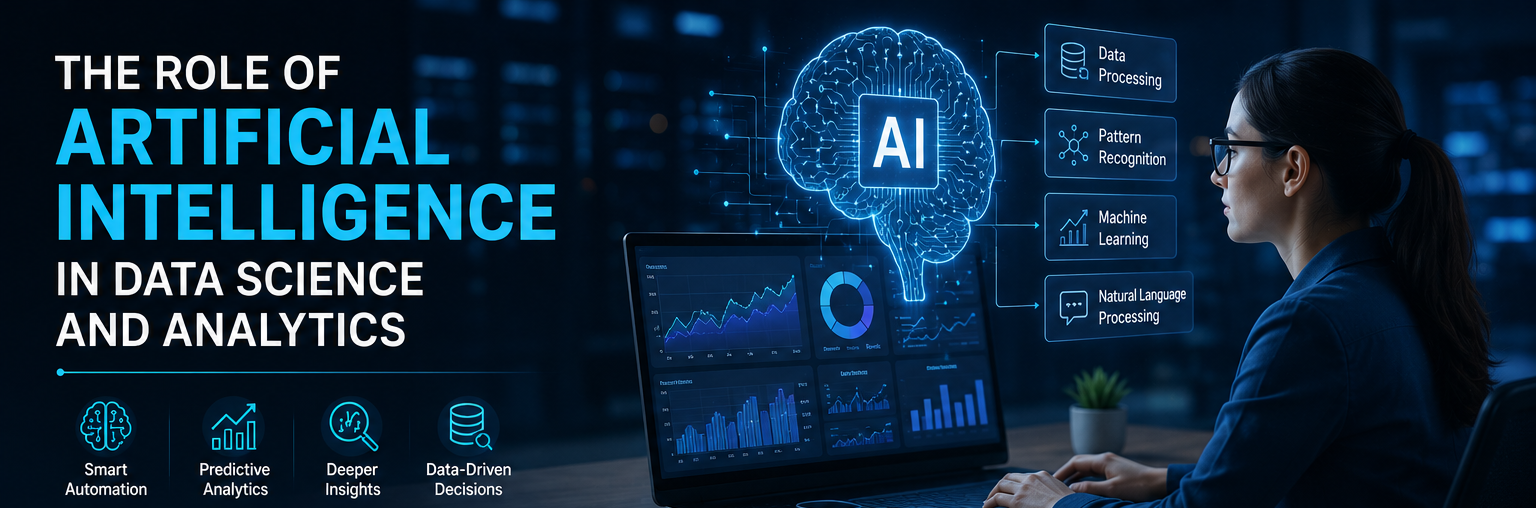
Artificial intelligence (AI) has become one of the most influential technologies in the modern digital world. From healthcare and banking to e-commerce and manufacturing, organizations generate enormous amounts of data every day. However, collecting data alone does not create value. Businesses need effective methods to analyze that information, identify patterns, predict outcomes, and make better decisions.
This is where the role of artificial intelligence in data science and analytics becomes increasingly important. AI allows data professionals to process complex datasets, automate repetitive analytical tasks, detect hidden patterns, and generate predictions more efficiently.
As organizations continue to become more data-driven, the combination of artificial intelligence, data science, and advanced analytics is changing how businesses understand information and make strategic decisions.
What Is Artificial Intelligence?
Artificial intelligence refers to computer systems designed to perform tasks that normally require aspects of human intelligence. These tasks can include recognizing patterns, understanding language, solving problems, making predictions, and learning from previous information.
AI includes several technologies and techniques, such as:
- Machine learning
- Deep learning
- Natural language processing
- Computer vision
- Generative AI
- Predictive modeling
- Intelligent automation
Rather than relying only on fixed instructions, many AI systems can learn relationships from data and improve their predictions as they receive more relevant information.
What Is Data Science?
Data science is the process of collecting, organizing, analyzing, and interpreting data to generate useful insights.
It combines several disciplines, including mathematics, statistics, programming, machine learning, and domain knowledge.
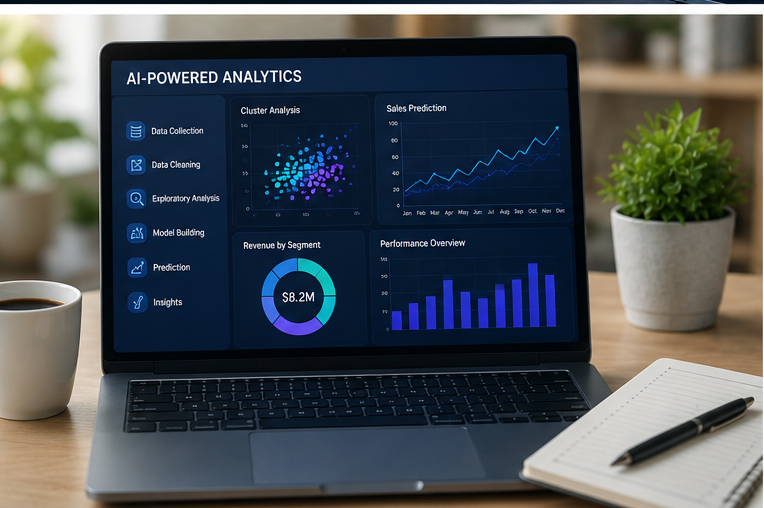
A typical data science process may involve collecting data from different sources, cleaning it, exploring patterns, developing analytical models, evaluating results, and communicating findings.
The ultimate purpose is not simply to produce numbers. Data science helps organizations turn raw information into knowledge that can support practical decisions.
What Is Data Analytics?
Data analytics focuses on examining information to identify trends, relationships, performance patterns, and useful insights.
Businesses use analytics to answer questions such as:
Why are sales decreasing?
Which products are performing best?
Which customers are likely to leave?
Which marketing campaign produces the highest return?
Where can operational costs be reduced?
AI makes it possible to answer increasingly complex questions by analyzing large amounts of information faster and discovering patterns that traditional approaches might overlook.
How AI Is Transforming Data Science and Analytics
Artificial intelligence is changing nearly every stage of the data science lifecycle.
Traditional analysis can involve significant manual work, particularly when professionals need to prepare datasets, select variables, build models, test different approaches, and interpret results.
AI-powered tools can assist with many of these activities.
This does not mean that data scientists are becoming unnecessary. Instead, AI can help professionals spend less time on repetitive processes and more time on interpretation, experimentation, strategy, and decision-making.
1. Automated Data Processing
Raw business data is rarely ready for immediate analysis.
Datasets may contain:
- Missing information
- Duplicate records
- Incorrect values
- Inconsistent formats
- Unnecessary information
- Data from incompatible sources
Preparing this information can consume a significant portion of an analytics project.
AI-assisted systems can help identify anomalies, detect duplicates, suggest transformations, classify information, and automate parts of the data-cleaning process.
Better data preparation can lead to faster analysis and more reliable results.
2. Machine Learning and Predictive Analytics
One of AI’s most important contributions to data science is machine learning.
Machine-learning algorithms analyze historical data to identify relationships that can be used to make predictions about future outcomes.
For example, a retailer could analyze previous sales, seasonal demand, customer behavior, promotions, and inventory information to estimate future product demand.
Financial organizations can use predictive models to assess risk, while subscription businesses can estimate which customers may be likely to cancel their services.
Predictive analytics helps organizations move from understanding what happened toward estimating what may happen next.
3. Faster Analysis of Large Datasets
Modern organizations can generate enormous quantities of information through websites, mobile applications, sensors, payment systems, social platforms, and connected devices.
Analyzing these datasets manually can be extremely difficult.
AI systems can process large volumes of structured and unstructured data and help analysts identify important relationships more efficiently.
This capability is particularly valuable in industries where decisions depend on rapidly changing information.
4. Natural Language Processing
Natural language processing (NLP) enables computer systems to analyze and work with human language.
A large amount of valuable business information exists as unstructured text, including:
- Customer reviews
- Emails
- Survey responses
- Support conversations
- Documents
- Social media discussions
- Reports
Traditional numerical analysis may struggle to extract insights from this information.
NLP can help organizations classify text, identify topics, summarize information, extract important entities, and analyze customer sentiment.
For example, a company receiving thousands of customer reviews can use NLP-based analytics to identify frequently reported problems.
5. AI-Powered Business Intelligence
Business intelligence platforms traditionally rely on dashboards, charts, reports, and manually defined queries.
AI is making these systems more interactive.
Modern analytics tools can allow users to ask questions using natural language rather than writing complicated database queries.
A business manager might ask:
“Which product category experienced the strongest growth this quarter?”
An AI-assisted analytics platform can interpret the question, analyze relevant information, and help generate a suitable visualization or explanation.
This can make data analysis accessible to employees who are not professional data scientists.
6. Real-Time Analytics
Many businesses cannot afford to wait days or weeks for important insights.
AI can support real-time or near-real-time analytics by continuously analyzing incoming information.
Consider an online payment platform processing thousands of transactions. AI-based systems can examine transaction characteristics and identify unusual behavior that may require further investigation.
Similarly, manufacturers can analyze equipment sensor information to identify warning signs before a machine experiences a major failure.
Faster analytics can help organizations respond to problems and opportunities more quickly.
7. Fraud and Anomaly Detection
AI is particularly useful for detecting unusual patterns.
Machine-learning models can establish typical behavior within a dataset and identify activities that differ significantly from expected patterns.
This can be useful in:
- Banking
- Insurance
- E-commerce
- Cybersecurity
- Telecommunications
- Online payments
However, an unusual pattern does not automatically prove fraud. Human investigation and appropriate controls remain important, especially when automated decisions could significantly affect individuals.
8. Customer Behavior Analysis
Understanding customers is one of the most valuable applications of data analytics.
Businesses collect information from purchases, websites, applications, customer-service interactions, and marketing campaigns.
AI can analyze this information to identify patterns in customer preferences and behavior.
For example, an e-commerce company might use AI to understand which products customers frequently purchase together. This information can improve recommendations, inventory planning, and marketing strategies.
Organizations can also segment customers based on behavior instead of relying only on basic demographic categories.
9. Personalized Recommendations
Recommendation systems are a familiar example of AI-powered analytics.
Streaming platforms can recommend movies or programs based on viewing behavior, while online stores can suggest products based on previous purchases and browsing activity.
These systems analyze patterns across large numbers of users and products.
Effective personalization can improve customer experience because people spend less time searching through irrelevant options.
At the same time, organizations should use personal information responsibly and clearly communicate how relevant data is collected and used.
10. Generative AI in Data Analytics
Generative AI is creating new opportunities within data science.
AI assistants can help analysts write code, explain statistical concepts, generate documentation, summarize analytical findings, and explore possible approaches to a problem.
They may also help users translate complex analytical results into easier-to-understand business language.
For example, after analyzing quarterly sales data, a generative AI system might help summarize major trends for management.
However, AI-generated conclusions should be verified. Generative systems can produce incorrect interpretations, so human review remains essential.
Benefits of AI in Data Science and Analytics
Increased Efficiency
AI can automate repetitive analytical processes, allowing data professionals to focus on higher-value activities.
Better Predictions
Machine-learning models can identify complex relationships in historical information and support more sophisticated forecasting.
Faster Decision-Making
Organizations can analyze information more quickly and respond to changing business conditions.
Improved Customer Understanding
AI helps companies discover patterns in customer behavior, preferences, and feedback.
Scalable Analysis
AI systems can analyze datasets that would be extremely difficult to process manually.
Greater Accessibility
Natural-language analytics tools can allow non-technical employees to interact with business information more easily.
Real-World Applications of AI and Data Analytics
Healthcare
Healthcare organizations can use AI and analytics to study medical data, support research, optimize hospital operations, and identify patterns that may assist healthcare professionals.
Because medical decisions can have serious consequences, AI systems in healthcare require strong validation, privacy protection, and professional oversight.
Finance
Financial institutions use AI for risk analysis, fraud detection, customer analytics, forecasting, and operational automation.
AI models can examine large numbers of transactions and identify patterns requiring additional investigation.
Retail and E-Commerce
Retailers use AI-driven analytics for demand forecasting, recommendations, customer segmentation, inventory planning, and marketing optimization.
Manufacturing
Manufacturers can analyze information from machines and sensors to predict maintenance requirements, monitor production quality, and improve operational efficiency.
Marketing
AI-powered analytics helps marketers understand campaign performance, audience behavior, customer journeys, and conversion patterns.
This enables companies to make marketing decisions based on measurable information rather than assumptions.
Challenges of Using AI in Data Science
AI provides significant benefits, but it also introduces important challenges.
Data Quality
AI models depend heavily on the information used to train and operate them.
Incomplete, inaccurate, outdated, or biased data can produce unreliable results.
This is why data quality management remains essential even when advanced AI technologies are available.
Bias
If historical datasets contain unfair patterns, AI systems may learn and reproduce those patterns.
Organizations need appropriate testing, monitoring, and governance to identify potential bias.
Privacy and Security
AI systems can process significant amounts of personal and business information.
Companies must establish appropriate security controls, access management, data protection policies, and compliance procedures.
Lack of Transparency
Some advanced AI models can be difficult to interpret.
Organizations may need to understand why a model produced a particular recommendation, especially when decisions affect finance, employment, healthcare, or other high-impact areas.
Overdependence on Automation
AI should not automatically be treated as correct.
Models can fail because of poor data, changing conditions, inappropriate assumptions, or technical limitations.
Human oversight remains an important part of responsible analytics.
Will AI Replace Data Scientists?
AI is more likely to change data science jobs than completely eliminate them.
Many routine activities can become increasingly automated. However, organizations still need professionals who can understand business problems, evaluate data quality, select appropriate methods, verify model performance, interpret findings, and communicate results.
The most valuable data professionals may increasingly be those who know how to combine traditional analytical expertise with AI tools.
Skills such as critical thinking, statistics, programming, business understanding, communication, and AI literacy will remain important.
Best Practices for Using AI in Data Analytics
Organizations should treat AI as part of a broader data strategy rather than simply adopting it because it is popular.
A responsible approach should include high-quality data, clearly defined objectives, appropriate model testing, privacy protection, cybersecurity measures, human oversight, and continuous monitoring.
Businesses should also ensure that analytical results can be understood by the people responsible for making decisions.
AI is most valuable when it helps humans make better-informed decisions rather than replacing thoughtful decision-making.
The Future of AI in Data Science and Analytics
The relationship between AI and data analytics will continue to develop.
Future analytics platforms are likely to become more automated, conversational, personalized, and accessible.
Users may increasingly interact with business data through AI assistants that can generate visualizations, summarize trends, identify anomalies, and suggest possible explanations.
Automated machine learning may also reduce some of the technical work required to create predictive models.
At the same time, responsible AI governance will become increasingly important. Organizations will need stronger processes for managing privacy, security, accuracy, transparency, and fairness.
The future of data science will therefore involve both technological advancement and responsible human oversight.
Conclusion
The role of artificial intelligence in data science and analytics is becoming increasingly important as organizations generate larger and more complex datasets.
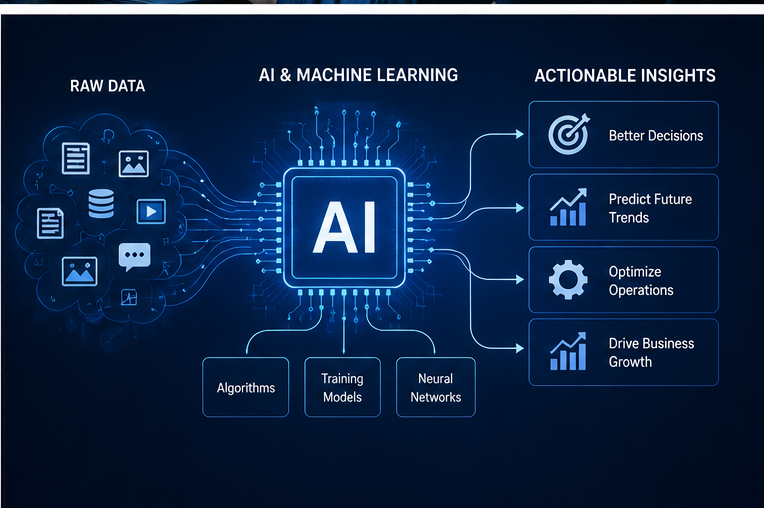
AI can help automate data preparation, improve predictive analytics, process unstructured information, detect unusual patterns, understand customer behavior, and support faster business decisions.
Machine learning, natural language processing, generative AI, and intelligent analytics platforms are making data analysis more powerful and accessible.
However, successful AI-driven analytics requires more than sophisticated algorithms. High-quality data, skilled professionals, strong security, ethical practices, and human judgment remain essential.
Organizations that combine artificial intelligence with responsible data science practices can transform raw information into meaningful insights and use those insights to make smarter, faster, and more informed decisions.